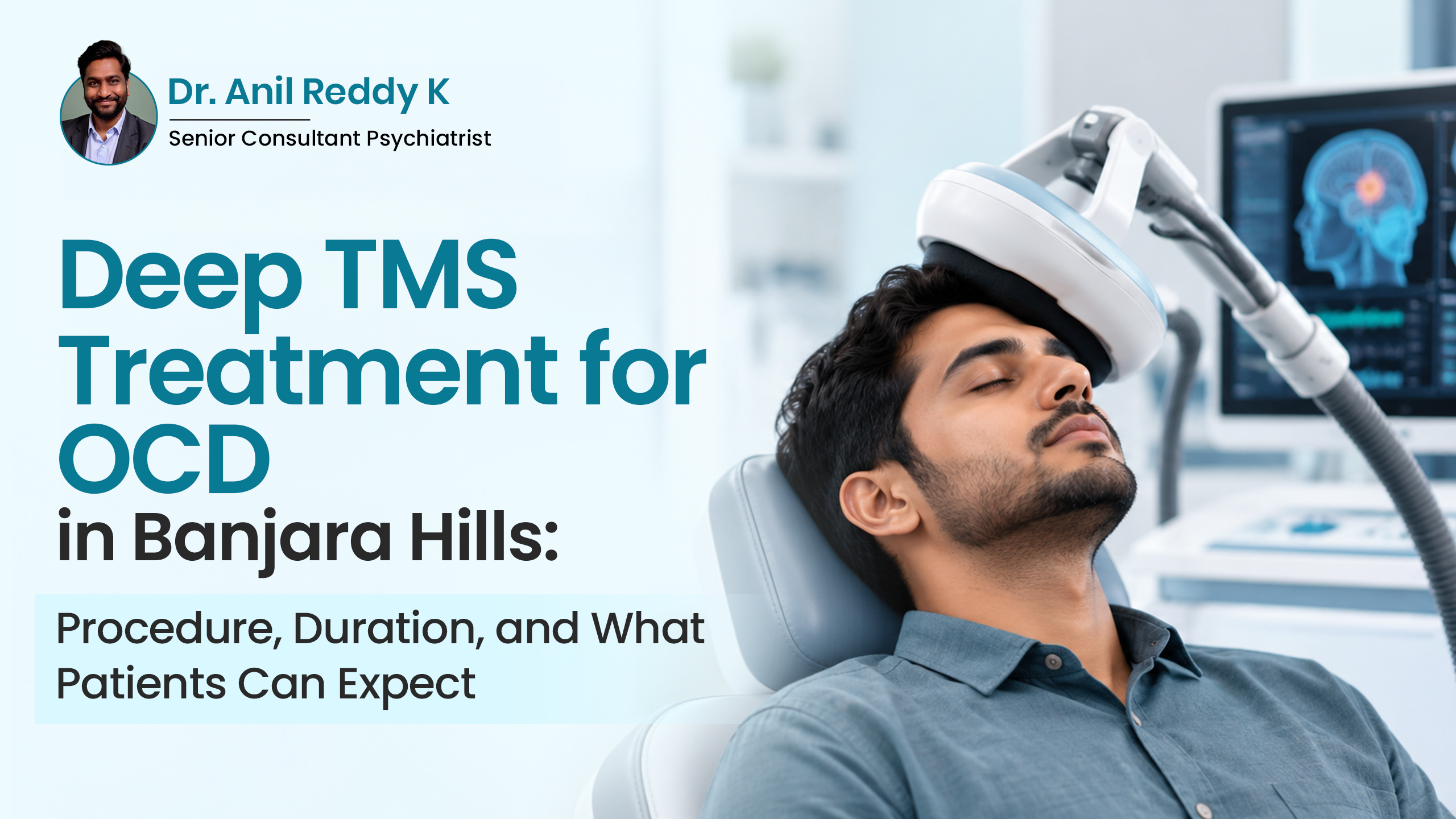
Repetitive thoughts and unwanted urges can make everyday activities difficult to manage. For some individuals, obsessive-compulsive disorder (OCD) continues to affect daily life even after trying conventional treatment. In such situations, a psychiatrist may evaluate whether additional treatment options could be appropriate.
Deep transcranial magnetic stimulation (Deep TMS) is a non-invasive treatment that uses magnetic pulses to stimulate specific brain regions involved in mood, behaviour, and thought regulation. It may be considered for selected patients with OCD as part of a broader treatment plan.
Understanding how the procedure works, how long sessions take, and what to expect during treatment can help patients make informed decisions about their mental health care.
For individuals exploring deep TMS treatment for OCD in Banjara Hills, a psychiatric evaluation can help determine whether this approach is suitable for their symptoms and treatment history.
What Is Deep TMS for OCD?
Deep transcranial magnetic stimulation is a non-invasive brain stimulation technique that uses magnetic fields to influence activity in targeted brain networks.
In OCD, individuals may experience persistent intrusive thoughts, anxiety, and repetitive behaviours or mental rituals intended to reduce distress. These symptoms can interfere with work, relationships, personal responsibilities, and everyday routines.
Deep TMS uses a specialised electromagnetic coil positioned against the scalp to deliver magnetic pulses to targeted brain areas. Certain Deep TMS systems have specific protocols cleared by the US Food and Drug Administration for OCD. Availability, approved indications, and treatment protocols can vary by country and device.
Deep TMS does not involve surgery, and patients generally remain awake during sessions. It may be considered alongside other established OCD treatments following an appropriate psychiatric assessment.
Understanding Obsessive-Compulsive Disorder
OCD is a mental health condition characterised by obsessions, compulsions, or both.
Obsessions
Obsessions are unwanted, recurring thoughts, images, or urges that cause distress or anxiety.
Common examples include:
- Persistent concerns about germs or contamination
- Repeated doubts about whether something has been done correctly
- Fear of causing accidental harm
- A strong need for symmetry or things to feel just right
- Disturbing thoughts that feel difficult to dismiss
These thoughts are not necessarily consistent with the person’s wishes or values. However, the distress they cause may make it difficult to focus on other activities.
Compulsions
Compulsions are repetitive actions or mental rituals that a person feels driven to perform, often in response to an obsession.
Examples include:
- Washing hands repeatedly
- Checking locks, appliances, or switches several times
- Repeating words or phrases mentally
- Arranging objects in a particular order
- Seeking repeated reassurance
- Repeating tasks until they feel complete
Although compulsions may provide temporary relief, the anxiety can return, creating a recurring cycle of obsessions and compulsions.
How OCD Affects Daily Life
OCD symptoms can consume considerable time and interfere with ordinary routines. Some people may be late for work because of repeated checking, while others may avoid social activities due to contamination fears.
The severity varies between individuals. A professional assessment can help establish the nature of the symptoms and identify suitable treatment options.
When Is Deep TMS Considered for OCD?
Deep TMS may be considered for certain individuals whose OCD symptoms remain difficult to manage with conventional treatment.
A psychiatrist may review whether the patient has previously tried appropriate medication, psychotherapy, or exposure and response prevention (ERP), a specialised form of cognitive behavioural therapy.
Factors that may be considered include:
- The severity and duration of OCD symptoms
- The effect of symptoms on daily functioning
- Previous treatment approaches and their outcomes
- Current medications and other mental health concerns
- Medical history and suitability for brain stimulation
- The patient’s treatment goals and preferences
Deep TMS is not necessary for everyone with OCD and is not guaranteed to eliminate symptoms. A psychiatrist should explain its potential benefits, limitations, risks, and alternatives before treatment begins.
How Does the Deep TMS Procedure Work?
The procedure is generally performed in a clinical setting without the need for surgery or general anaesthesia.
1. Initial Psychiatric Evaluation
The process begins with an assessment of the patient’s symptoms, medical history, previous treatments, and current medications.
The psychiatrist determines whether OCD is the primary concern and whether Deep TMS may be appropriate. Other conditions and potential contraindications are also considered.
2. Treatment Planning and Positioning
If the patient is considered suitable, the clinical team identifies the appropriate treatment protocol and positions the stimulation coil.
The coil is placed against the scalp using the device-specific positioning method. Treatment settings are selected according to the prescribed protocol and individual clinical requirements.
3. Delivery of Magnetic Pulses
During a session, the device delivers repeated magnetic pulses to the targeted brain region.
Patients remain awake and can usually sit comfortably throughout the procedure. They may hear clicking sounds from the equipment or experience tapping sensations on the scalp.
The intensity and treatment settings are established by the clinical team rather than selected independently by the patient.
4. Monitoring During Treatment
The healthcare team monitors the patient’s comfort and response during sessions. Some individuals experience temporary scalp discomfort or headaches, particularly during the initial sessions.
Patients should inform the clinical team about any unusual symptoms or concerns.
5. Return to Daily Activities
Deep TMS is generally an outpatient procedure. Most patients can resume their usual activities after a session, depending on how they feel and the advice of their treating team.
How Long Does Deep TMS Treatment for OCD Take?
The duration depends on the device, the prescribed protocol, and the patient’s clinical needs.
| Treatment stage | What to expect |
| Initial consultation | Symptom assessment and suitability evaluation |
| Individual session | Often approximately 20–30 minutes, depending on the protocol |
| Overall treatment course | Commonly several weeks, with many protocols involving weekday sessions |
| Follow-up | Review of symptoms, response, side effects, and further care |
These timings are general estimates, not a fixed schedule for every patient. The specific OCD protocol and equipment used by the treating clinic determine the actual session duration and number of visits.
Patients should also account for additional time for preparation, positioning, and clinical review.
What Results Can Patients Expect From Deep TMS?
Treatment response varies from person to person. Some patients may experience a reduction in the frequency or intensity of obsessive thoughts, while others may notice changes in compulsive behaviours or the distress associated with their symptoms.
Improvement may develop gradually over the course of treatment rather than immediately after the first session.
Patients should understand that:
- Results are not guaranteed.
- Symptoms may improve to different degrees.
- Some individuals may experience limited or no improvement.
- Ongoing psychiatric care may still be necessary.
- Further treatment or maintenance sessions may be discussed when clinically appropriate.
Symptom tracking and regular follow-up can help the psychiatrist evaluate progress and decide whether the treatment plan needs adjustment.
Deep TMS and Other OCD Treatment Options
Deep TMS is one of several approaches that may be considered in OCD management. The most suitable option depends on symptom severity, treatment history, patient preference, and clinical assessment.
Cognitive Behavioural Therapy and ERP
Exposure and response prevention is a specialised therapy in which patients gradually confront anxiety-provoking thoughts or situations while learning to resist compulsive responses.
ERP is an established treatment for OCD and can help individuals develop healthier responses to distress.
Medication
Psychiatrists may prescribe selective serotonin reuptake inhibitors (SSRIs) or other appropriate medication strategies, depending on the patient’s symptoms and treatment history.
Medication choice and dosage require professional supervision. Patients should not stop or change prescribed medicines without consulting their treating clinician.
Deep TMS
Deep TMS may be considered for selected patients, including some whose symptoms have not improved sufficiently with conventional approaches.
It is important to discuss how the treatment compares with available alternatives, the strength of evidence for the proposed protocol, potential risks, costs, and expected outcomes.
A psychiatrist can help patients understand these options and develop an individualised treatment plan.
Why Professional Psychiatric Guidance Matters
OCD symptoms can overlap with anxiety disorders and other mental health conditions. A careful assessment helps distinguish between these concerns and determine the most appropriate treatment.
Individuals seeking OCD Treatment in Banjara Hills can discuss their symptoms, previous treatment experiences, and concerns about available therapies with a qualified psychiatrist.
Professional guidance is particularly important before considering a specialised procedure such as Deep TMS. Treatment should be selected based on clinical suitability rather than the assumption that one approach works for everyone.
Deep TMS Care for OCD in Banjara Hills
Managing OCD may require patience, a clear treatment plan, and regular assessment of symptoms. While intrusive thoughts and repetitive behaviours can be distressing, several evidence-based treatment options are available.
Dr. Anil Reddy K provides psychiatric evaluation and treatment planning for individuals experiencing OCD and other mental health concerns. An assessment can help clarify the symptoms, review previous treatments, and determine which options may be appropriate.
Patients can discuss:
- OCD symptoms and their effect on daily life
- Previous medication and psychotherapy
- The potential role of specialised treatment options
- Possible risks, benefits, and limitations
- Follow-up and long-term symptom management
Individuals searching for the Best psychiatrist in Banjara Hills should prioritise a qualified professional who provides a careful assessment, explains treatment choices clearly, and supports ongoing care.
Frequently Asked Questions (FAQs)
1. Is Deep TMS effective for OCD?
Deep TMS may reduce OCD symptoms in some patients, but the response varies. Its suitability depends on the individual and the treatment protocol. A psychiatrist can explain the available evidence, expected benefits, and limitations.
2. How many Deep TMS sessions are required for OCD?
Treatment often involves sessions on weekdays over several weeks. The total number of sessions and their duration depend on the specific device, prescribed protocol, and individual treatment plan.
3. Is Deep TMS painful?
Deep TMS is generally performed without anaesthesia. Patients may experience tapping sensations, scalp discomfort, or a headache during or after treatment. These effects are often temporary, but any persistent or concerning symptoms should be reported to the clinical team.
4. Can Deep TMS replace OCD medication or therapy?
Not necessarily. Deep TMS may be considered alongside or after other treatments, depending on clinical circumstances. Patients should not discontinue medication or psychotherapy without discussing the decision with their treating psychiatrist.
5. Can patients return to normal activities after Deep TMS?
Most patients can resume their regular activities after a session. However, individual responses may vary, so patients should follow the clinical team’s advice and report any side effects that interfere with daily functioning.
Consult Dr. Anil Reddy K for OCD Treatment in Banjara Hills
OCD can affect concentration, relationships, routines, and overall quality of life. Understanding the available treatment options is an important step toward managing symptoms and improving everyday functioning.
Dr. Anil Reddy K offers psychiatric assessment and personalised treatment planning based on each patient’s symptoms, medical history, and treatment needs. A consultation can help determine whether conventional treatment, specialised interventions, or a combination of approaches may be appropriate.
Website: https://dranilreddykpsychiatrist.com/
Phone: 96666 55558
