When Your Body Is Sick – Your Mind Hurts Too. Here’s the Help You Didn’t Know Existed.
Imagine this: Your doctor tells you that your heart surgery went perfectly. The stitches have healed. Your test results are normal. But every morning, you wake up with a heavy feeling in your chest – not physical pain, but a deep sadness and fear that won’t go away. You wonder: Is something still wrong with me? Am I going crazy?
You are not going crazy. And you are not alone.
This is one of the most common yet least talked-about experiences in healthcare when a physical illness leaves behind an invisible wound on your mental health. A specialised branch of psychiatry called Consultation-Liaison Psychiatry (CLP) exists precisely to treat this. And understanding it could change your life, or the life of someone you love.
| Consultation-Liaison Psychiatry (CLP) treats both your mind and body at the same time – because they cannot truly heal separately. |
What Is Consultation-Liaison Psychiatry?
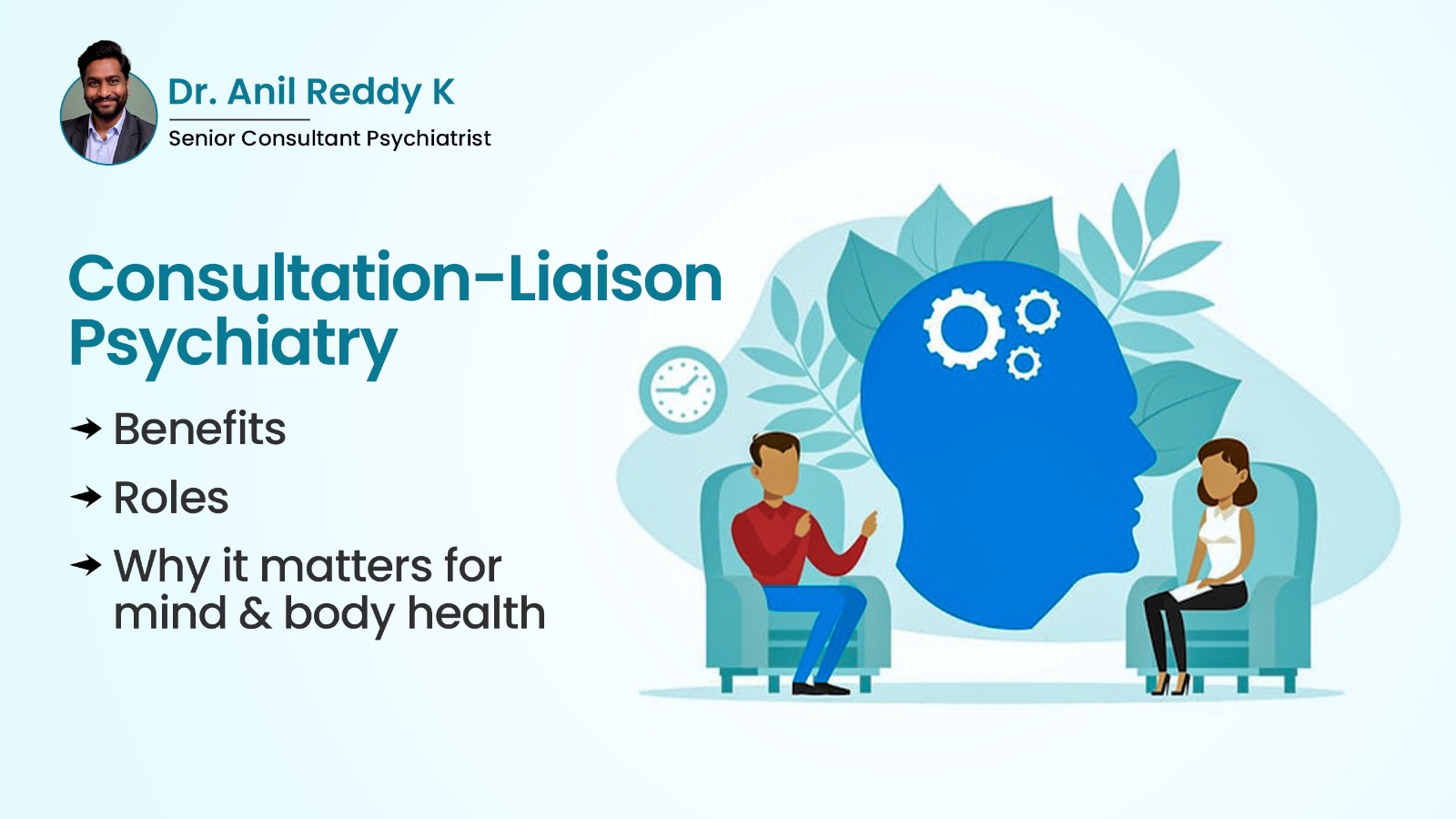
Consultation-Liaison Psychiatry also called Psychosomatic Medicine, Wellbeing Medicine, or Integrated Behavioral Health is a specialty where psychiatrists work alongside your regular doctors inside the hospital.
Think of it this way: Your cardiologist treats your heart. Your oncologist treats your cancer. But who treats the fear, grief, sleeplessness, and hopelessness that often come with these diseases? That is exactly what a Consultation-Liaison Psychiatrist does.
They are the bridge between your physical health and your mental health and they work right there in the same hospital, as part of your care team.
Real Stories: People Just Like You
The best way to understand CLP is through real situations that many people face. These stories reflect the kinds of patients seen every day in hospitals across Hyderabad.
| Ravi, 58 – IT Professional, Hyderabad
Heart Attack Survivor Who Couldn’t Leave His Bedroom Ravi survived a heart attack six months ago. His cardiologist declared him fit to return to work. But Ravi couldn’t bring himself to go back. He was terrified of dying, refused to climb stairs, stopped going out, and became completely dependent on his wife. His family thought he was being dramatic. He thought he was going mad. In reality, Ravi had developed Post-Cardiac Depression and Anxiety – a very common condition after heart attacks that goes completely undiagnosed in most hospitals. What helped: A liaison psychiatrist joined Ravi’s care team. Through a combination of therapy and low-dose medication, Ravi was back at work within three months – and his cardiac health actually improved because he started exercising again. |
| Priya, 34 – Teacher, Secunderabad
Chest Pain That No Doctor Could Explain Priya visited three different hospitals over eight months with severe chest pain, breathlessness, and a racing heart. Every ECG, every scan, every blood test came back normal. Doctors would shrug and say ‘you’re fine.’ But Priya knew something was wrong. She was embarrassed and frustrated. She eventually saw a psychiatrist who identified Panic Disorder – a psychiatric condition that produces intensely real physical symptoms. Priya had been suffering from a mental health condition all along, but it was presenting entirely as physical pain. What helped: After eight months of unnecessary tests and fear, six weeks of CBT (Cognitive Behavioural Therapy) and medication resolved Priya’s symptoms almost completely. |
| Krishnamurthy, 66 – Retired Banker, Banjara Hills
Suddenly ‘Going Mad’ After Hip Surgery Three days after a routine hip replacement surgery, Krishnamurthy’s family noticed he was talking to people who weren’t there, becoming aggressive at night, and refusing to eat. His family was frightened and assumed it was the start of dementia. The ward doctor called the liaison psychiatrist, who immediately identified Delirium – a temporary but serious condition of acute confusion caused by pain, medication interactions, and the stress of surgery. It is extremely common in elderly patients and often mistaken for permanent mental illness. What helped: The CLP team adjusted his medications, improved his sleep environment, and had him calm and lucid within five days. His family was educated about what had happened so they wouldn’t panic if it occurred again. |
How Do You Know If You (or a Loved One) Need This Help?
Many people suffer silently because they don’t know where to turn or they feel ashamed about mental health. Here is a simple guide. If you recognise any of these situations, please don’t wait to seek help:
| If You or Someone You Know… | It Could Be… | CLP Can Help With… |
| Feels constant sadness after a heart attack or surgery | Depression after medical illness | Therapy + medication alongside medical care |
| Gets chest pain but doctors say heart is fine | Anxiety or panic disorder | Psychiatric assessment, breathing techniques, CBT |
| Can’t sleep, feels agitated after cancer diagnosis | Adjustment disorder / acute stress | Counselling, coping strategies, family support |
| Elderly parent becomes confused after hospitalisation | Delirium (a medical emergency) | Rapid evaluation, medication review, environment changes |
| Diabetic patient keeps skipping medication | Untreated depression affecting adherence | Integrated psychiatric + diabetes care |
| Person hears voices or sees things during illness | Neuropsychiatric manifestation of illness | Specialist psychiatric consultation |
You do not need to have a formal psychiatric diagnosis to ask for help. If something feels wrong emotionally or physically, it is always worth talking to a specialist.
What Actually Happens When You See a Liaison Psychiatrist?
Many people are nervous about seeing a psychiatrist. Here is exactly what you can expect — there is nothing to fear.
Step 1: A Calm, Private Conversation
Your psychiatrist will sit with you (and your family if you wish) and simply talk. They will ask about your feelings, your sleep, your appetite, your fears, and your daily life. There is no judgement. Everything is confidential.
Step 2: A Thorough Assessment
They will review your medical history, your current medications, and your physical health alongside your mental symptoms. This holistic view is what makes CLP so effective — they see the full picture, not just one part of you.
Step 3: A Personalised Plan
Your plan might include one or more of the following:
- Psychotherapy (talk therapy) – such as CBT or supportive therapy to help you process difficult emotions
- Medication – carefully chosen to not interfere with your existing medical treatment
- Family counselling – helping your loved ones support you more effectively
- Coordination with your medical team – the psychiatrist talks directly to your surgeon, physician, or oncologist
- Crisis support – if you are in acute distress, rapid help is available
Step 4: Ongoing Support
You will not be left on your own after one visit. Liaison psychiatry is continuous – your psychiatrist stays involved throughout your treatment journey.
Why Integrated Care Works Better: The Real Benefits
| Benefit | What It Means for You |
| Faster Recovery | Your mind heals alongside your body — recovery is quicker and more complete |
| Better Treatment Adherence | You are more likely to follow your doctor’s advice when your mental health is supported |
| Fewer Hospital Readmissions | Integrated care addresses root causes, reducing the chance of coming back to hospital |
| Improved Quality of Life | Emotional well-being, coping skills, and resilience all improve together |
| Family Support | Your loved ones get guidance, reducing their stress and caregiver burden |
| Cost Savings | Early intervention prevents expensive crisis care and prolonged hospitalisation |
Common Myths About Seeing a Psychiatrist – Busted
Myth 1: “Seeing a psychiatrist means I’m weak or mad.”
Fact: Seeing a psychiatrist means you are smart enough to get the right help. Mental health is a medical matter — just like diabetes or high blood pressure. Millions of successful, healthy people see psychiatrists regularly.
Myth 2: “My problem is physical, not mental. Psychiatry can’t help me.”
Fact: As the real stories above show, physical and mental health are deeply intertwined. A broken leg affects your mood. Severe depression can cause very real physical pain. Treating both together produces far better outcomes than treating either alone.
Myth 3: “Psychiatric medication will make me dependent or change my personality.”
Fact: Modern psychiatric medications are carefully prescribed, monitored, and adjusted. They are tools to help you function better — not to alter who you are. Your psychiatrist will always discuss options with you before prescribing anything.
Myth 4: “I should just be strong and handle it myself.”
Fact: Struggling emotionally during a serious illness is not weakness — it is a normal human response to an abnormal situation. Asking for help is the strongest thing you can do for yourself and your family.
When Should You Reach Out? (Don’t Wait)
Please consider speaking to a psychiatrist if you or someone you care about:
- Has been diagnosed with a serious physical illness and feels hopeless, terrified, or unable to function
- Is refusing medical treatment without a clear rational reason
- Has unexplained physical symptoms that doctors cannot find a cause for
- Became confused, aggressive, or seems ‘not themselves’ after hospitalisation or surgery
- Has been managing a chronic illness (diabetes, heart disease, cancer) but is struggling with depression or anxiety
- Is caring for a sick family member and feels completely overwhelmed and burnt out
- Has been told ‘there’s nothing wrong’ by doctors but still feels terrible
You do not have to wait for a crisis. Early help means faster recovery and better outcomes.
Conclusion: Your Mind and Body Are Not Separate – And Your Care Shouldn’t Be Either
For too long, medicine has treated the body in one room and the mind in another. Consultation-Liaison Psychiatry is changing that placing mental health care right inside the hospital, alongside your medical team, so that you are treated as a whole person.
Whether you are recovering from surgery, managing a chronic disease, processing a frightening diagnosis, or watching a loved one suffer know that help exists. Real, evidence-based, compassionate help that treats both your mind and your body together.
The stories in this article are not rare exceptions. They happen every day in hospitals across Hyderabad. The only difference between those who recovered fully and those who continued to suffer was access to the right kind of care at the right time.
If something doesn’t feel right physically or emotionally please reach out. You deserve to heal completely.
You Don’t Have to Face This Alone
If you or a loved one is struggling with both physical and emotional health – the right help exists.
Consult Dr. Anil Reddy K
Senior Consultant Psychiatrist | 15+ Years Experience | Hyderabad
Asha Hospitals, Banjara Hills – +91 96666 55558
Edge Clinic, Hitech City – +91 63032 85050